Medallion presented to Bransby Beauchamp Cooper after England vs Victoria cricket tour match, 1873
View this record on the National Museum of Australia's website
Sign in to save favourites.
- Type
- Medallions
- Place
- Victoria, Australia; England
- Materials
- Metal - non specific
- Collection
- Bransby Beauchamp Cooper collection
- Accession number
- 2006.0093.0001
Description
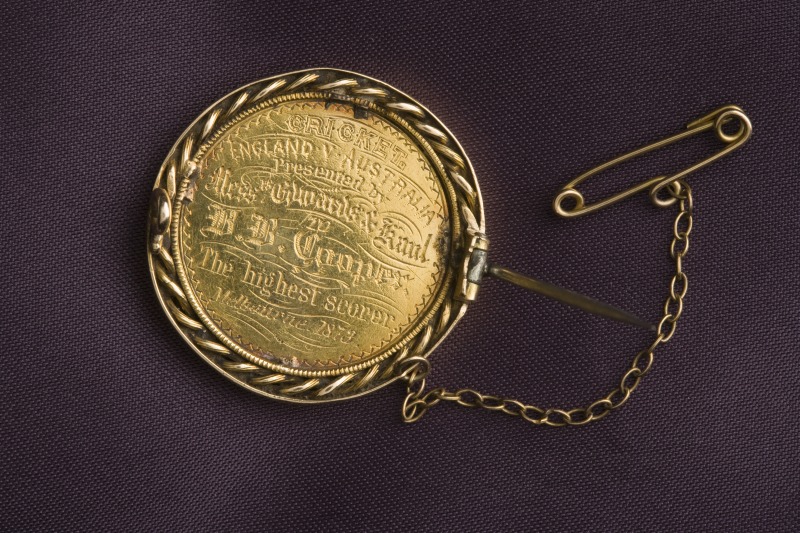
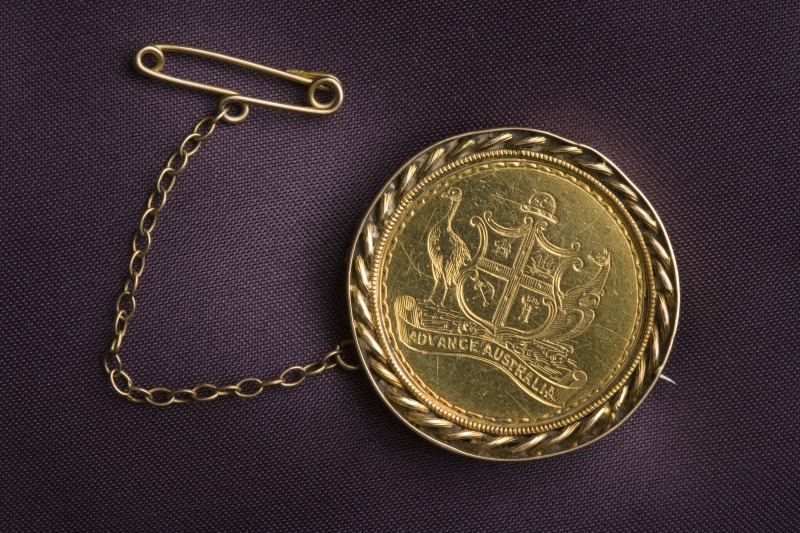
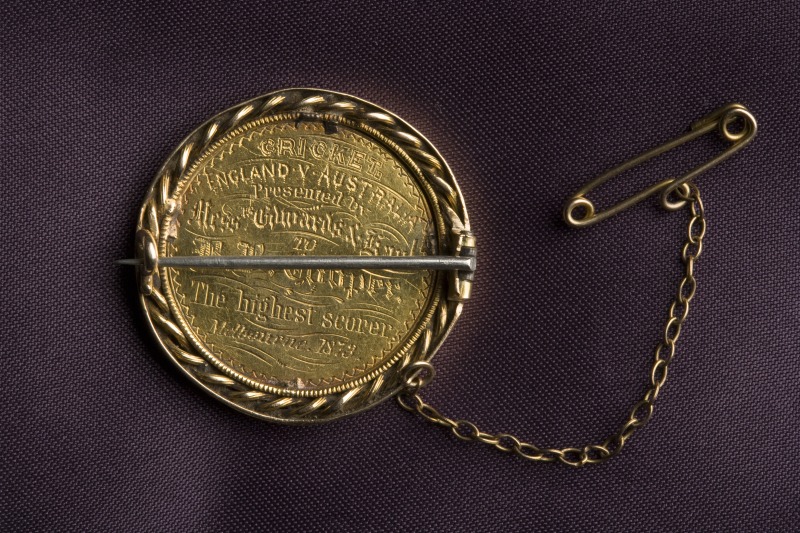
A gold coloured metal medallion onto which is attached a fine gold-linked chain ending in a gold safety pin. The obverse of the medallion is etched with the Australian coat-of-arms, below which is a scroll below reading "ADVANCE AUSTRALIA". The reverse features a straight pin running from each side, and bears the inscription "CRICKET / ENGLAND .V. AUSTRALIA / ... / BB COOPER / The highest scorer / Melbourne 1873". The face of the medallion is surrounded by a gold chain, and the edge is surrounded by a flat strip of metal.
About the collection
The Bransby Beauchamp Cooper collection consists of a gold medallion presented to the cricketer BB Cooper. This medallion was presented to him after achieving the then highest score of 84 for Victoria in a cricket match against an English side led by WG Grace in 1873. Bransby Beauchamp Cooper was born in Dacca on the sub-continent in 1844 before moving to England. He had a first class cricket career playing with the Rugby school, as well as Kent and Middlesex. In 1869, Cooper moved to Geelong, Victoria, and continued his love affair with the game. He played eleven inter-colonial matches for Victoria and top-scored for a Victorian XVIII that took on an English XI lead by WG Grace in 1873. This match was watched by over 40 000 spectators and saw the Victorian team beat Grace's English side by an innings and 21 runs. The year 1877 saw the first official XI versus XI test match between a united Australian side and an English touring side. Cooper played in this match and is officially the third Australian test cricketer to be capped. Cooper scored a disappointing fifteen and three, and did not go on to represent Australia in any further test matches. He spent his remaining years in Victoria where he died in 1914, aged 70.
Read live from the Museum's Collection API (12/11/2026, 4:58:26 am). Record last updated by the Museum 2025-02-17. Licence: https://creativecommons.org/licenses/by-nc/4.0/.