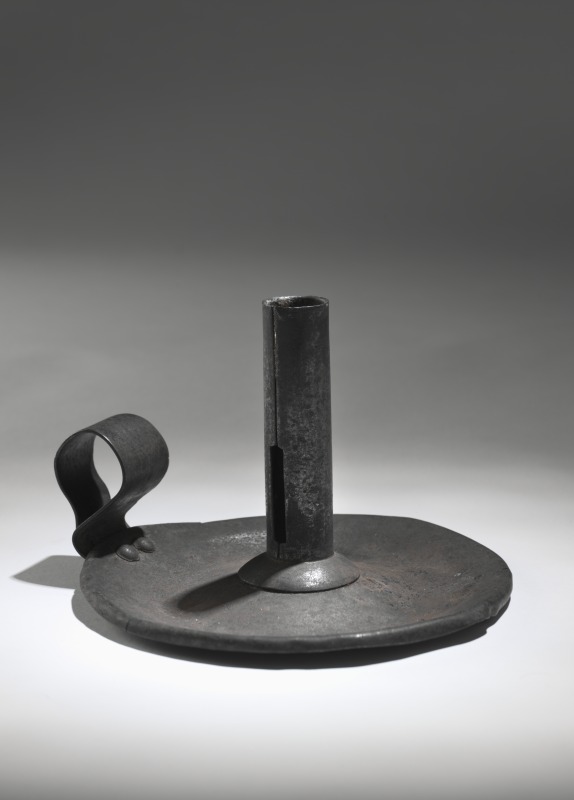
Metal candle holder comprising metal dish with looped handle at edge and vertical cylinder at centre
View this record on the National Museum of Australia's website
Sign in to save favourites.
- Type
- Candle holders
- Date
- 1829
- Place
- Granton, Hobart, Tasmania, Australia
- Materials
- Metal - non specific
- Collection
- Convict Era Shirt collection
- Accession number
- 2006.0096.0004
Description
A metal candle holder, that has a metal dish with a looped handle at the edge and vertical cylinder at the centre. The cylinder has a split down one side which widens at the bottom, showing the inside of the cylinder and some bent metal strips attached there. In the top of the cylinder there is debris and remains of a wick. The cylinder and the metal loop are both appear to be riveted on to the base.
About the collection
The Convict Era Shirt collection comprises six convict era artefacts found at the Commandant's Cottage in Granton, Tasmania during renovations in the 1960s.The collection includes a convict era shirt c.1830, a convict punishment shoe, a Government-issue metal candle holder impressed with a broad arrow mark, a whale oil burning lamp with original convex magnifying lens, a waisted iron axe with an impressed crown over a broad arrow, and a pair of handcuffs marked 'Froggatt Warrented Wrought Iron'. A secondary punishment station was established at Bridgewater in 1829 to build a causeway across the Derwent. Approximately 200 convicts were employed, in chains, to erect the Commandant's cottage, convict barracks, the Black Snake inn and to break stones to form the foundation of the causeway. This was a difficult and punishing task, and the project was abandoned seven years later uncompleted. The significance of the shirt, as one of only two surviving examples of such a ubiquitous article of clothing, is given added importance due to the circumstances that led to its and the shoe's preservation. The shirt had been placed into a wall cavity and the shoe was placed under the floor. Both items appear to have been deliberately concealed in the cottage by its convict builders as a 'house sacrifice', a folk practice common in England from the 1400s.
Read live from the Museum's Collection API (12/11/2026, 5:46:53 am). Record last updated by the Museum 2025-02-23. Licence: https://creativecommons.org/licenses/by-nc/4.0/.