Jute bale pack
View this record on the National Museum of Australia's website
Sign in to save favourites.
- Type
- Bags
- Materials
- Textile - non specific
- Collection
- Julie and Antoine Bos collection
- Accession number
- 2000.0036.0002
Description
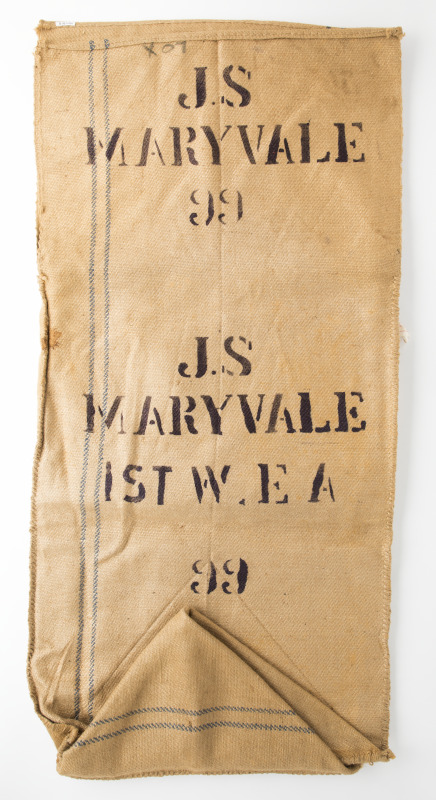
A large light brown rectangular bale bag made from hessian (jute). The bag is formed from one long rectangular piece of jute with two smaller rectangular pieces hand sewn together to form a four sided bag. "J.S/MARYVALE/99/J.S/MARYVALE/1ST/W.EA/99" is stencilled on one side of the bag.Two blue stripes are woven into the material on each of the four panels. When folded the bag sits flat and forms a rectangular shape with a triangular bottom.
About the collection
The Julie and Antoine Bos collection consists of items of wool production technology, shearer's furniture and domestic household technology. The wool production technology - wool bale scales, bale stencils, and bale pack - complete existing NMA collections illustrating shearing shed technology and extend geographic, temporal and material range of existing stencil collections. The shearer's furniture - bed frames, stool, bench, cupboard, buckets and water heater - illustrate living conditions and cultural priorities for itinerant shearers between the 1920's and 1960's, and demonstrate rural traditions of 'make-do' furniture. The importance of the wool industry to Australian economic, social and symbolic history indicates the significance of these conditions. These items of household technology - ice chest, food safe and gas stove - constitute examples of typical household appliances used in Australia during the first half of the twentieth century. They represent objects of aspiration for many Australians, in their time being regarded as modern and progressive, and illustrate conditions of life and domestic labour for many Australian men and women. The 'Esky' and 'Kooka' brands are iconic in terms of Australian domestic life.
Read live from the Museum's Collection API (12/11/2026, 6:54:38 am). Record last updated by the Museum 2025-02-17. Licence: https://creativecommons.org/licenses/by-nc/4.0/.