Hot-air steriliser
View this record on the National Museum of Australia's website
Sign in to save favourites.
- Type
- Health and medical equipment
- Date
- 1903
- Place
- London, England
- Materials
- Ceramic, Copper, Steel
- Collection
- School of Public Health and Tropical Medicine collection
- Accession number
- 1986.0063.0033
Description
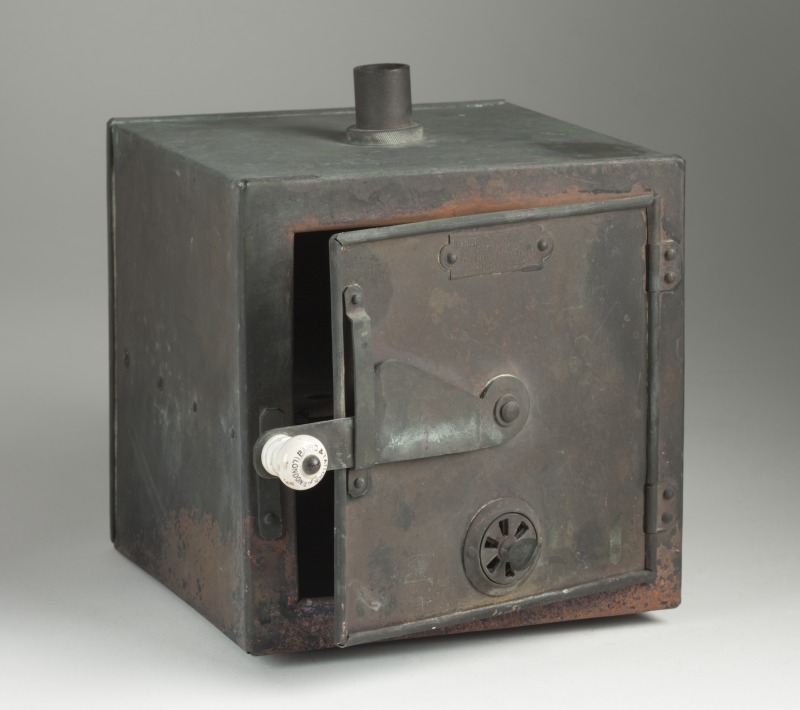
A cubic metal box with a hinged front door which can be opened by a latched handle to reveal a sliding central shelf with circular perforations. The latch has a ceramic knob inscribed with "BAIRD AND TATLOCK (LONDON) LTD". A label attached to the knob is typed with "OVEN WAX EMBEDING (sic) (139)". The front of the door features a circular ventilation aperture with a screw open/close section, and the top of the box has a central cylinder attached into which a screw can be fitted. There is a plaque on the front reading "BAIRD AND TATLOCK (LONDON) LTD / Cross Street, Hatton Garden / LONDON, E.C.".
The absolute necessity for sterilising medical and surgical instruments in the laboratory to prevent the spread of infectious made the hot-air sterilisers, or hot-air ovens, important tools. A wide range of sterilisers were available during the early twentieth century as awareness of the importance of sterilisation increased. All bacteria and spores are destroyed on glass and metallic items when heated in hot-air over a 30 minute period at 150°C (302°F), or faster at a higher temperature. Hot-air sterilisers are simply double-walled metal boxes, mounted on stands and heated from below by the flame from a Bunsen burner. The base of the oven contained firebrick plates that were replaced when broken or worn out. A thermometer was placed through the hole in the top of the box to indicate the internal temperature. This hot-air steriliser is small, portable and versatile, and would have been used for sterilising instruments in surgery and chemical analysis, including scalpels and test tubes, at the Australian Institute of Tropical Medicine. The Baird and Tatlock company was established in Glasgow in 1881 by Hugh Harper Baird (d. 1911) and John Tatlock (c.1842-1909). The company opened a London branch in 1889. The Baird and Tatlock partnership dissolved in 1896, with Baird operating in London, and Tatlock in Glasgow, beginning a series of disputes between the companies about naming rights to the Baird and Tatlock brand as each opened numerous branches and formed other partnerships. To sterilise glass test tubes in the hot air steriliser, the tubes were placed on a metal rack inside the oven, the door closed and the ventilating slide on the door open. The gas Bunsen burner was lit below, and the oven heated over that flame. When the internal temperature reached 100°C (212°F), the ventilating slide was closed. At 175°C (347°F), the gas was extinguished and the oven allowed to cool with the door remaining closed. To avoid cracking the tubes, the door was open only after the oven temperature had dropped to 60°C (140°F). To keep metal items, such as knives, scissors, and forceps from being damaged, they were packed in a metal box and then placed inside the hot-air steriliser and heated to 130°C (266°F) for 30 minutes.
Read live from the Museum's Collection API (12/11/2026, 6:20:34 am). Record last updated by the Museum 2026-09-08. Licence: https://creativecommons.org/licenses/by-nc/4.0/.