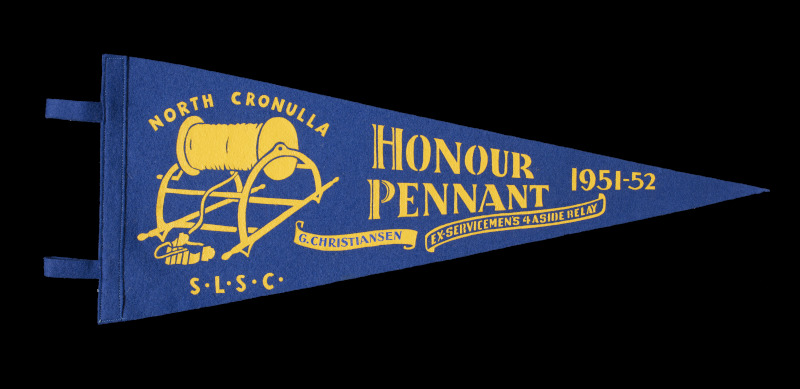
Surf life saving honour pennant for Ex-Servicemen's 4 A Side Relay, North Cronulla 1951-52, awarded to G. Christiansen
View this record on the National Museum of Australia's website
Sign in to save favourites.

- Type
- Pennants
- Date
- 1951 - 1952
- Materials
- Felted cloth - non specific, Paint - non specific
- Collection
- Geoff Christiansen collection
- Accession number
- 2007.0069.0008
Description
A triangular blue felt pennant featuring printed yellow text and an image. The text reads "NORTH CRONULLA / S.L.S.C / HONOUR / PENNANT / 1951-52 / G. CHRISTIANSEN "EX-SERVICEMEN'S 4 A SIDE RELAY". The image is of surf lifesaving equipment, the reel, line and belt. At the edge opposite the point the pennant has two felt loops attached under a band of self coloured felt. On the back is a manufacturer's label which reads "J B Dillon/ 17 O'CONNELL ST / SYDNEY".
About the collection
The Geoff Christiansen collection consists of two Speedo swimsuits worn in surf lifesaving competitions in the 1950s, six felt pennants and four photographs. Geoff Christiansen was an active surf lifesaver from 1941 to 1960, during which time he was a member of Clovelly, North Cronulla and Newcastle Surf Life Saving Clubs. It was the sporting element of surf lifesaving which particularly attracted Christiansen to the organisation and he competed in Rescue and Resuscitation teams and individual surf races at club, intra-club, state and national level from the 1940s to 1960. His story is typical of many surf lifesavers of that period. The Australian surf lifesaving movement was established in the early twentieth century as a response to the growing popularity of surf bathing and local beach conditions. It began on the beaches of Sydney then spread around the country, first to Perth and southern Queensland then later to the other capital cities and coastal regions. It has been argued that the appearance of surf lifesavers in the early twentieth century made the beach a safer place and contributed to a growing enthusiasm for the beach. Yet surf lifesavers have taken on a much greater role than guardians of the beach. They have become cultural icons.
Read live from the Museum's Collection API (12/11/2026, 5:07:27 am). Record last updated by the Museum 2026-07-01. Licence: https://creativecommons.org/licenses/by-nc/4.0/.