Cassis Cornuta (Cassidae)
View this record on the National Museum of Australia's website
Sign in to save favourites.
- Type
- Shells
- Place
- Bathurst Island, Tiwi Islands, Northern Territory, Australia
- Materials
- Shell
- Collection
- Lady Helen Blackburn collection
- Accession number
- 1988.0129.0018
Description
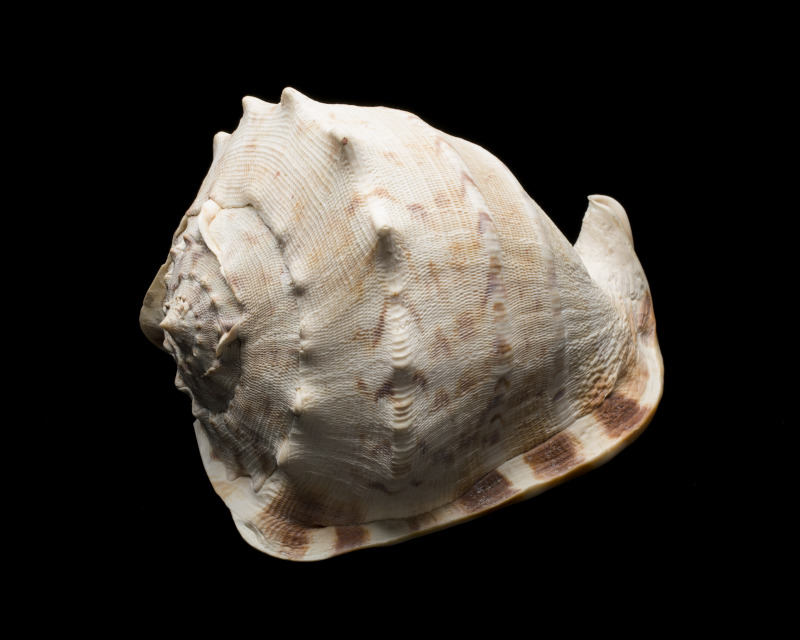
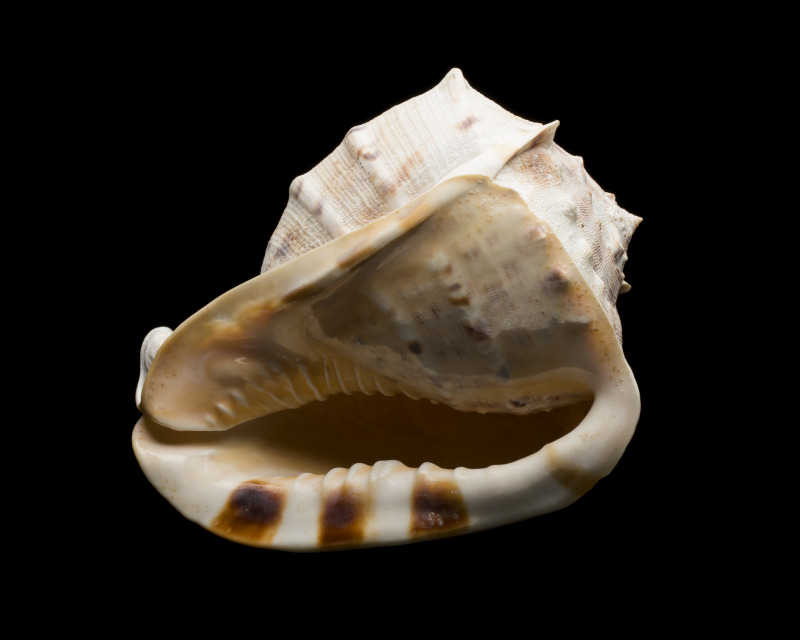
A large light coloured shell with a shiny peach coloured interior. The shell is a Cassis Cornuta (Cassidae)(Linne 1758) and has a conical spiral shape with raised points along the outside of the spiral.
The common name of the Cassis Cornuta is the horned helmet . The Lady Helen Blackburn collection features more than five hundred seashells from Australian beaches, reefs and islands. Lady Helen Blackburn was born Bryony Helen Dutton in 1918, the third of four children to a pioneering pastoralist family. She grew up on the historic Anlaby Station near Kapunda (the oldest stud sheep station in South Australia) and formed a close relationship with her younger brother Geoffrey Dutton, who would become a celebrated poet, novelist and historian. The Dutton family spent summers at Rocky Point, the beloved family holiday home on the north coast of Kangaroo Island, where Helen's curiosity and love of nature led to a passion for shell collecting that would last a lifetime. In 1951, Helen married lawyer Richard Blackburn (later Sir Richard). They lived in Adelaide and started a family. Rocky Point remained a focal holiday destination, and Helen's passion for shell collecting continued to thrive. "Shell collecting has been my greatest joy in life", she later wrote. "Just walking on a good beach, hoping to find beach specimens has made me as happy as hunting for live specimens." (Lady Helen Blackburn collection file: National Museum of Australia). In 1966, Richard was appointed resident judge of the Supreme Court of the Northern Territory, where he presided over the first Aboriginal land rights case heard in an Australian court: Milirrpum v Nabalco (1971). During her time in the Northern Territory, Helen pursued her passion for collecting shells. She visited the Gove Peninsula of Arnhem Land (the country of the Yolngu people of Yirrkala) with her husband, and took the opportunity to search for shells. Such was her skill and reputation for shell collecting, that she did so on behalf of several major institutions, including the Australian, Darwin, Tasmanian and Western Australian Museums, the CSIRO and the University of New South Wales. Helen corresponded regularly with other shell collectors around the world, exchanging information and swapping shells to build up her collection. Her malacological knowledge, moreover, was such that she wrote a book on the, "Marine shells of the Darwin area". One of the shells she presented to the Australian Museum had never before been described, and now carries her name: Cryptomya blackburnae.
Read live from the Museum's Collection API (12/11/2026, 6:16:05 am). Record last updated by the Museum 2025-02-23. Licence: https://creativecommons.org/licenses/by-nc/4.0/.