Convict love token from M.L., 1820
View this record on the National Museum of Australia's website
Sign in to save favourites.
- Type
- Convict love tokens
- Materials
- Metal - non specific
- Collection
- Timothy Millett collection
- Accession number
- 2008.0039.0043
Description
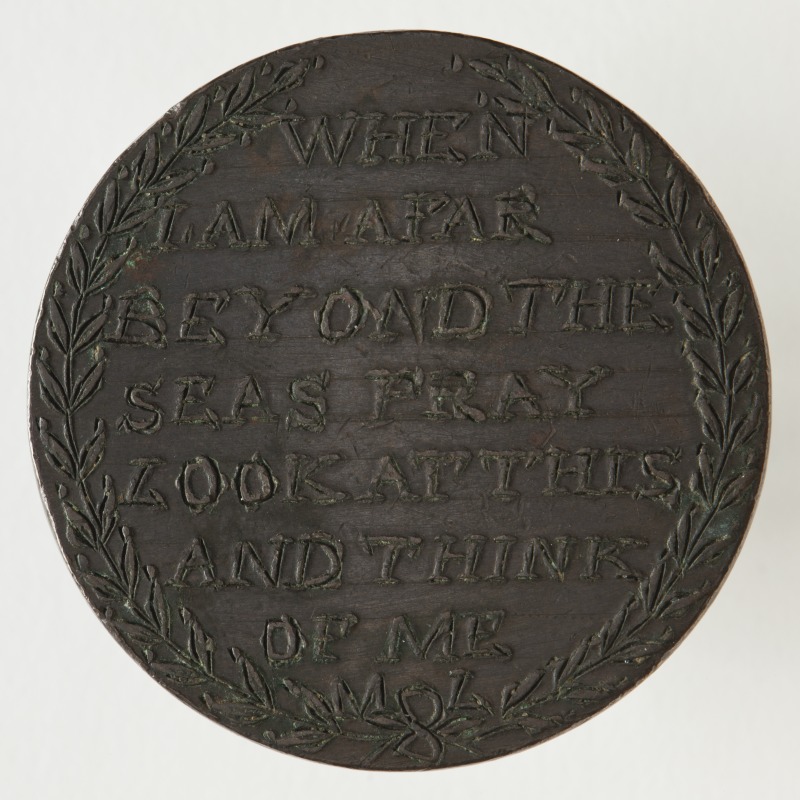
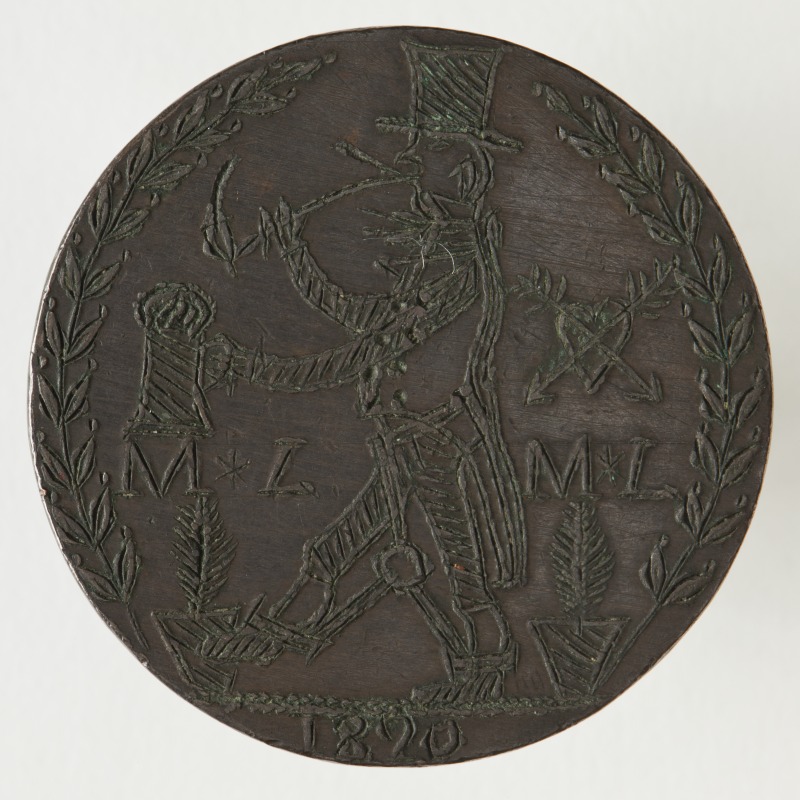
A convict love token, made up of a coin, engraved on both sides. One side shows a man walking in chains, smoking a pipe and holding what appears to be a tankard of beer, the initials 'M*L / M*L', potted plants, a crossed heart, the date '1820' and an ornate border. The other side features the text 'WHEN / I AM AFAR / BEYOND THE / SEAS PRAY / LOOK AT THIS / AND THINK / OF ME / M L' inside an ornate border.
This token may relate to Michael Lambert, 19, a jeweller, who was tried and convicted at the Middlesex Gaol Delivery on 17 February 1820 for coining - forged bank notes had been found in his possession. He was sentenced to 14 years' transportation. Later the same year, on 28 October, Mary Lambert, 18, thought to be Michael's wife, was tried and convicted at the Middlesex Gaol Delivery for the same offence. She was also sentenced to 14 years' transportation. The double monogram of ML on the token probably refers to both husband and wife. Michael Lambert sailed on the Guilford on 12 May 1820 arriving in Hobart on 28 October 1820. Mary Lambert sailed on the Providence on 6 June 1821 and arrived in Hobart on 18 December 1821.
About the collection
The Timothy Millett collection comprises 307 convict love tokens dating from 1762 to 1856, and seven contemporary documents relating to the criminal justice system including: recommendations to commute the death sentences of Hester Sampson and Thomas Hayes to life transportation; a calendar of prisoners awaiting trial in the goals of Durham, Newcastle and Northumberland; a request to the Middlesex assizes for rewards to be paid; a printed copy of George Skene's last speech prior to execution; a printed broadside listing prisoners in Dorchester jail awaiting transportation; and a 60 page handwritten account of the life of Thomas Jones, who was transported twice and finally hanged at Winchester Prison in 1856. Convict love tokens, typically made from smoothed-down coins and engraved or stippled with a message, derive from traditional sailors' farewells. The production of these 'leaden hearts' rose as criminal indictments increased in Britain, with the majority produced during the 1820s and 1830s. As mementos made by or for convicts facing transportation (or death) to leave behind for their loved ones, the tokens provide a poignant, personal insight into the transportation system.
Read live from the Museum's Collection API (12/11/2026, 6:16:10 am). Record last updated by the Museum 2026-08-10. Licence: https://creativecommons.org/licenses/by-nc/4.0/.