Convict love token from Samuel Sergent, 1830
View this record on the National Museum of Australia's website
Sign in to save favourites.
- Type
- Convict love tokens
- Materials
- Metal - non specific
- Collection
- Timothy Millett collection
- Accession number
- 2008.0039.0104
Description
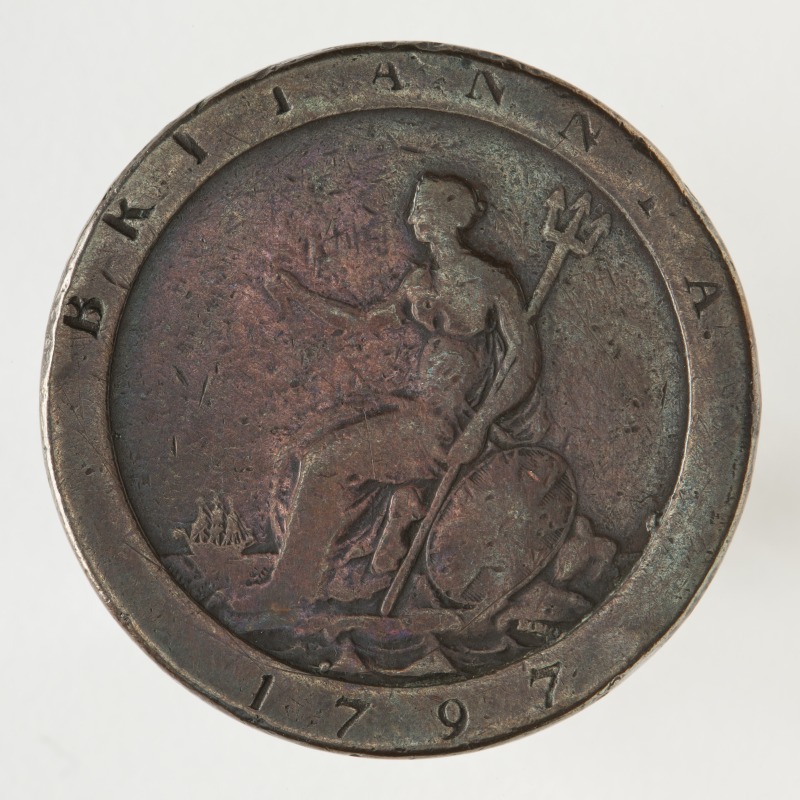
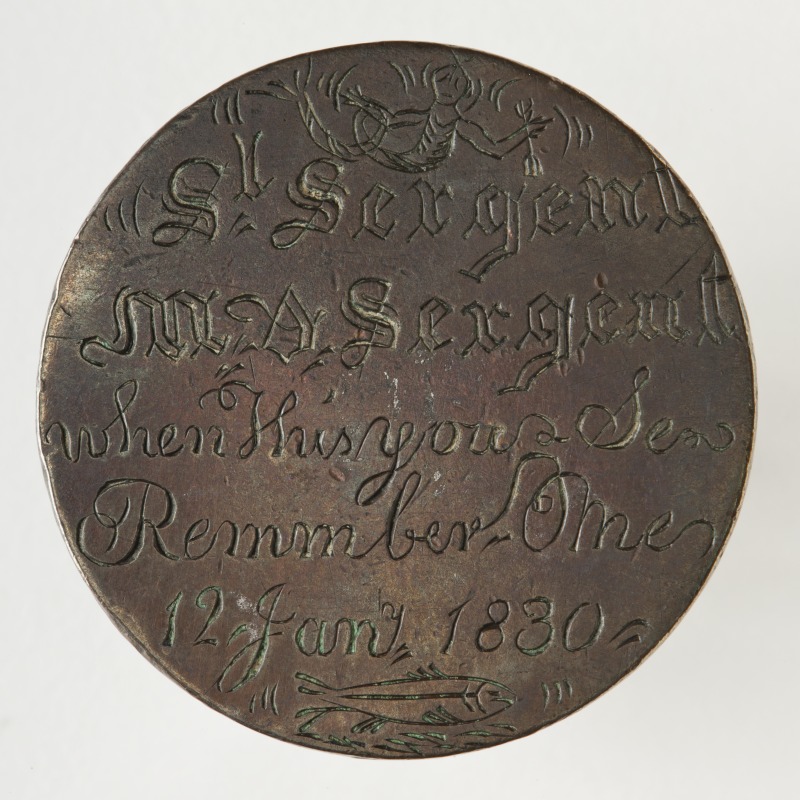
A convict love token, made up of a coin, engraved on one side. The engraved side features the text 'Sl. Sergent / M.A. Sergent / when This you Se [sic] / Remmber [sic] Me / 12 Jany 1830' as well as images of a mermaid holding a trident and a fish. The other side is the reverse of a cartwheel penny showing an image of 'BRITANNIA'.
It is likely that this token relates to Samuel Sargent, 30, jobbing smith, who was tried and convicted at Devon Quarter Sessions on 12 January 1830 for stealing some silver spoons and sugar tongs as well as a copy of The Pilgrim's Progress. He was sentenced to 14 years' transportation. At the time of his conviction, Sargent was married to Mary Ann, with whom he had one child, and to whom he probably gave this token. He spent almost three years on the hulks before sailing for Van Diemen's Land (Tasmania) on board the Circassian on 4 November 1832. On arrival, he was assigned to Thomas Gregson. After serving his sentence, he married Mary Lewis in 1845. He died in 1895.
About the collection
The Timothy Millett collection comprises 307 convict love tokens dating from 1762 to 1856, and seven contemporary documents relating to the criminal justice system including: recommendations to commute the death sentences of Hester Sampson and Thomas Hayes to life transportation; a calendar of prisoners awaiting trial in the goals of Durham, Newcastle and Northumberland; a request to the Middlesex assizes for rewards to be paid; a printed copy of George Skene's last speech prior to execution; a printed broadside listing prisoners in Dorchester jail awaiting transportation; and a 60 page handwritten account of the life of Thomas Jones, who was transported twice and finally hanged at Winchester Prison in 1856. Convict love tokens, typically made from smoothed-down coins and engraved or stippled with a message, derive from traditional sailors' farewells. The production of these 'leaden hearts' rose as criminal indictments increased in Britain, with the majority produced during the 1820s and 1830s. As mementos made by or for convicts facing transportation (or death) to leave behind for their loved ones, the tokens provide a poignant, personal insight into the transportation system.
Read live from the Museum's Collection API (12/11/2026, 6:20:36 am). Record last updated by the Museum 2026-08-10. Licence: https://creativecommons.org/licenses/by-nc/4.0/.