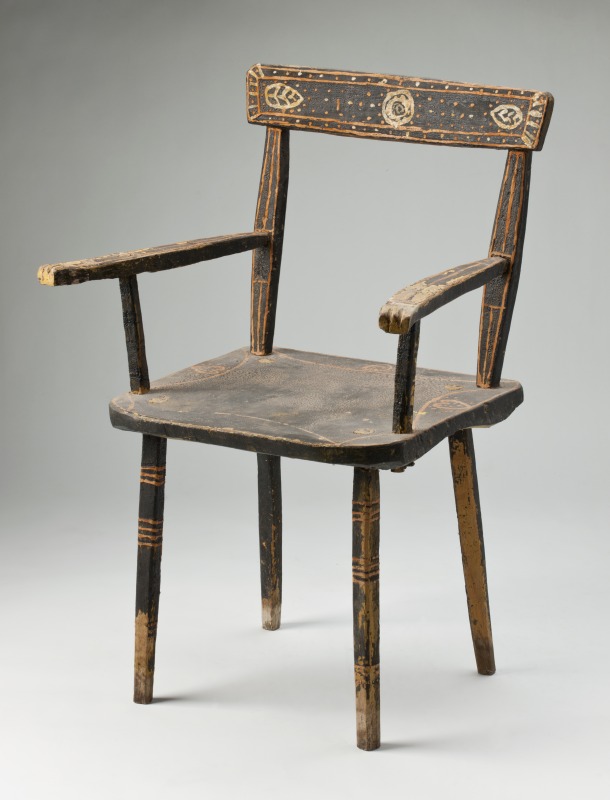
Armchair made by the Zilm family of Booleroo, SA, 1895
View this record on the National Museum of Australia's website
Sign in to save favourites.
- Type
- Chairs
- Date
- 1895
- Materials
- Paint - non specific, Wood
- Collection
- Zilm family furniture collection
- Accession number
- 2011.0025.0001
Description
A handmade painted wooden armchair, made with redgum and other eucalypt species. The chair structure features: a solid shaped seat supported by four angled square legs; a backrest with a broad and slightly curved top rail; and two curved armrests which terminate in decorative carved human knuckles (or closed fists). The leg and arm joinery are exposed on either side of the seat. Painted surface decoration in orange and white over black, includes stylised heart shaped elements on the seat, line markings, two leaf motifs and one central concentric circle motif on the top rail, and incorporates dashes and dots between motifs. On the underside of the seat, the year '1895' is punched with dots.
About the collection
This collection comprises a set of furniture made and used by the Zilm family, nineteenth-century Prussian settlers in South Australia's Barossa Valley. The four wooden armchairs and stool were hand-carved and constructed from Australian red gum and other eucalypts in 1895 and 1896. Three chairs were later painted black and decorated with a synthesis of central European folk and First Nations motifs using orange, red-brown and white paint. The side table with drafts/checkerboard top is decorated with red-brown paint and is thought to have been acquired by the family in the early twentieth-century. The collection retains its original form, condition and decoration, and is in excellent condition. The 'Zilm family furniture collection' has significance to broad areas of Australian social history, including the nineteenth-century migration of Germanic settlers and the transportation and re-establishment of traditional cultural practices such as carpentry and woodworking. This collection demonstrates the intermingling of European traditions and First Nations culture at the northern colonial frontier of South Australia. As a rare example of cross-cultural innovation, this significant collection represents the cultural impact of European settlement in South Australia.
Read live from the Museum's Collection API (12/11/2026, 5:21:40 am). Record last updated by the Museum 2025-06-25. Licence: https://creativecommons.org/licenses/by-nc/4.0/.