VK2 Velokraft recumbent bicycle used by Peter Heal
View this record on the National Museum of Australia's website
Sign in to save favourites.
- Type
- Bicycles
- Date
- 2009
- Materials
- Metal - non specific, Plastic - non specific, Rubber, Textile - non specific
- Collection
- Peter Heal collection
- Accession number
- 2013.0032.0001
Description
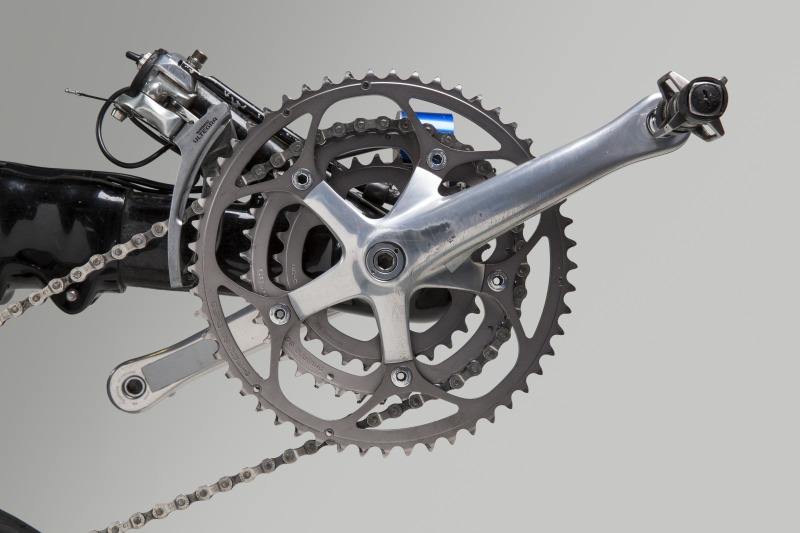
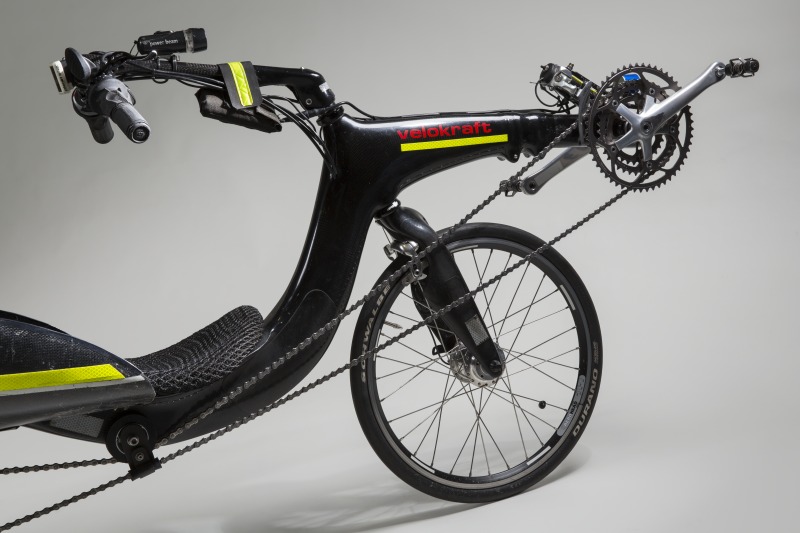
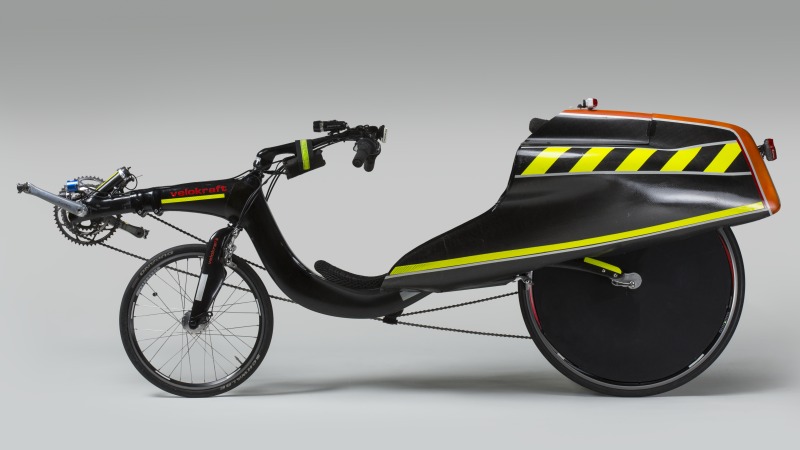
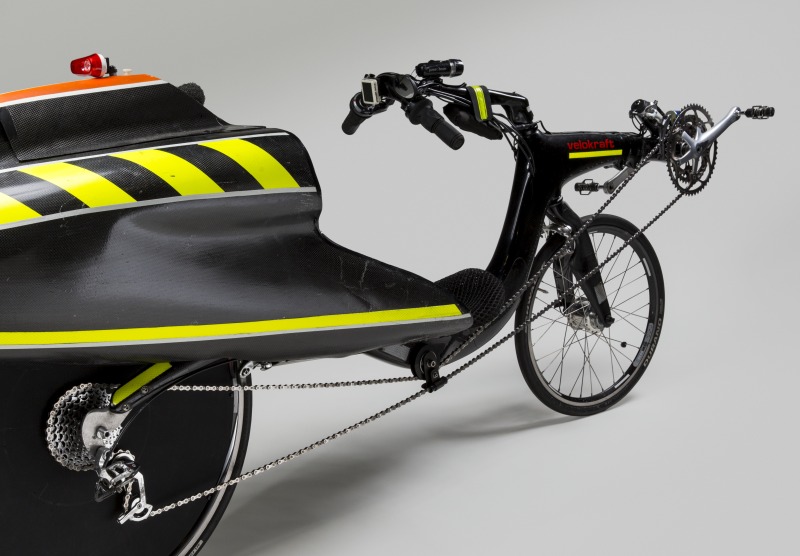
A recumbent bicycle with a black carbon fibre tailbox that has bright yellow stripes on the side and an orange stripe along the top. The two wheels are different sizes, and the larger rear wheel has black wheel cover. The pedals are in front of the front wheel. The steering is above seat. The text 'Velokraft ' is printed in orange on the frame at the front of the bike, and the orange colour also features on the top of the tailbox.
The recumbent used by Peter Heal to break the trans-Australia and around Australia cycling records in 2009 and 2010. In 2009 Heal pedaled this bike from Fremantle, Western Australia, to Sydney, New South Wales, in 11 days, 17 hours and eight minutes, breaking the record for a solo and unsupported crossing of continent by more than two days. The idea of the journey arose after Heal, a Canberra-based public servant and cycling enthusiast, began casting around for a new cycling challenge. After some research on the web, which revealed that the 'fully supported' cycling record for the Fremantle to Sydney crossing stood at 7 days 8 hours, Heal decided to attempt his own trans-Australia crossing; only in this case he would ride solo and without assistance. For Heal, the idea of an efficient human-powered vehicle being followed by a heavy motor home with flashing lights and a warning sign at 30kmh seemed ironic and wasteful. German cyclist Robert Seitz, who made the journey riding a M5 low racer recumbent bicycle in 14 days in 2004, held the previous solo record. To qualify as a solo and unsupported record, Heal's journey was required to follow an informally agreed upon route and pass through a number of towns identified as control points, where photographic evidence must be taken. Pre-arranged support in the form of picking up supplies at a friend's home or shelter was permitted in only four locations. No pre-arranged guides or drafting (riding behind another vehicle) was permitted. On both journeys undertaken in 2009 and 2010, Heal rode between 280 and 400 kilometres each day, and rested overnight in motels and roadhouses. Where no accommodation was available, he slept beside the road in a lightweight bivouac sleeping bag protected by a tarpaulin tent, both of which are included in this collection. Heal's focus for the ride was, in his words, 'ride, eat and sleep - repeat'. The bicycle also carried all the supplies Heal would require during the trip. The tailbox is made of lightweight carbon and is able to accommodate some essential tools and spare parts including two tyres, as well as clothes, water bladder etc. For sustenance, he carried a musette bag packed with muesli bars, muffins, bananas and chocolate bars under his left arm. This could be easily reached while cruising along. Heal also enjoyed 'Big Truckies' breakfasts from the roadhouses, typically eaten after a few hours cycling in the pre-dawn cold. He recalled that, 'most times these breakfasts resulted in significant increases to cruising speed!' He experienced near perfect conditions with favourable winds and fine sunny days almost every day. The roads across the Nullarbor were wide, smooth and fast. Heal boosted his speed by 'hyper-milling' on the smooth white line or the truck tyre slick line. The next year, 2010, Heal embarked on a second record-breaking journey. Also aboard this recumbent bicycle, he covered around 15,000 kilometers cycling alone around Australia in 48 days, 23 hours and 37 minutes. Again, this journey broke the previous record by approximately two days. Standing at 51 days 47 minutes, this had been established by Danish rider Erik Straarup in 2008. Erik's route was 14,611km. Heal continued further north, for a total distance of almost 15,000 kilometres, leaving from Sydney on 2 May 2010 and travelled anti-clockwise. As previously, the planned journey followed an informally agreed upon route, tracing the perimeter of the country, including some major deviations in remote areas where there are only rough dirt roads. A small selection of major towns were again nominated as controls to ensure the route is followed fully and Heal gathered photographic evidence along the way. On Saturday 19 June 2010, Heal rolled into Sydney and arrived at the Observatory Hill rotunda at around 23 minutes to midnight completing the 14,913 kilometre circumnavigation of Australia. He had averaged 304 kilometres per day with no rest days. A small crowd of good friends were present as Heal completed his journey with a 360 kilometre final leg (19 hours and 47 minutes) from Narooma, New South Wales, to Sydney CBD, which included about 4,000 metres of climbing.
About the collection
This collection consists of a VK2 Velokraft recumbent bicycle, Bivouac emergency sleeping bag and a tarpaulin tent belonging to Peter Heal, of Canberra, ACT. In 2009, Heal pedalled this bike from Fremantle to Sydney in 11 days, 17 hours and eight minutes, breaking the existing record for a solo and unsupported crossing of the continent by more than two days. The next year, Heal circumnavigated the continent in 48 days, 23 hours and 37 minutes; again lowering the previous record by approximately two days. The collection is in a good state of conservation. The bicycle has played an important role in Australia since the 1880s, both for sport and as means of transportation. The 'Peter Heal collection' offers insight into the continued fascination of trans-continental crossings for generations of Australian explorers, adventurers and athletes. Heal's endeavours represent the possibilities of the recumbent bicycle as a mode of human-powered transportation and the capacity of the human body for endurance over long distances.
Read live from the Museum's Collection API (12/11/2026, 5:22:15 am). Record last updated by the Museum 2025-02-17. Licence: https://creativecommons.org/licenses/by-nc/4.0/.