1871-72 Port Darwin to Java telegraph cable
View this record on the National Museum of Australia's website
Sign in to save favourites.
- Type
- Submarine cables
- Materials
- Hemp, Iron, Tar
- Collection
- Nextgen Group collection
- Accession number
- 2016.0013.0001
Description
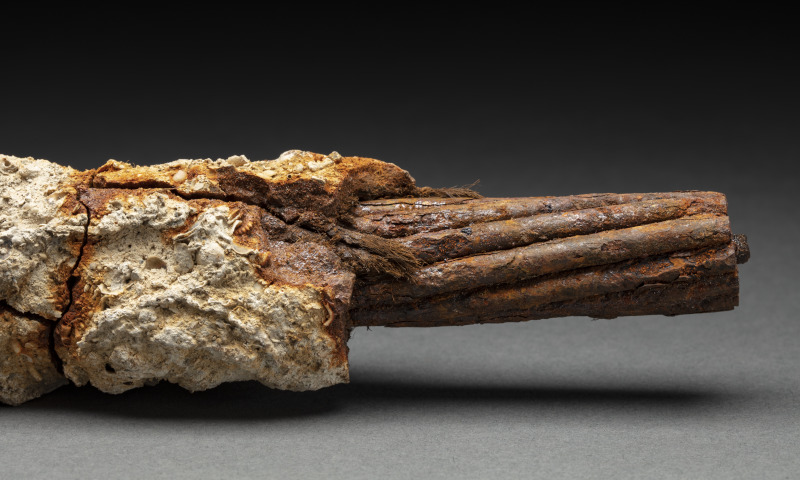
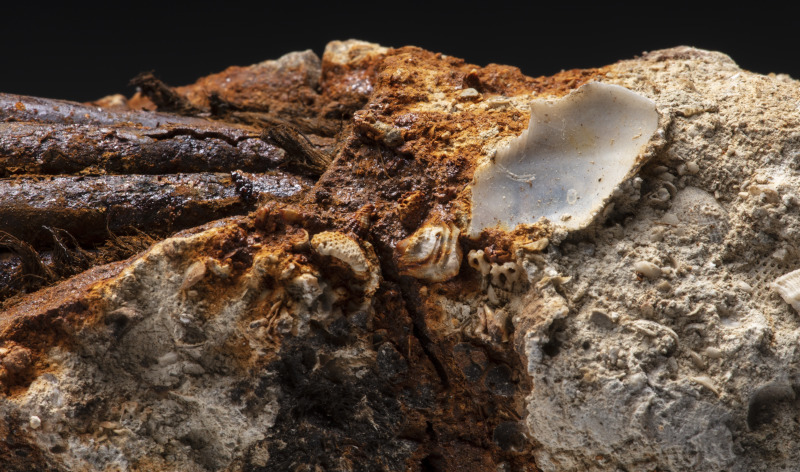
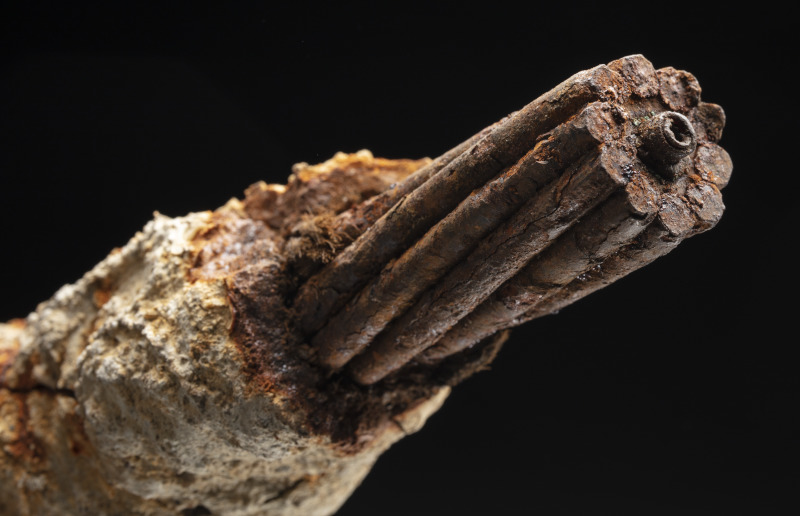
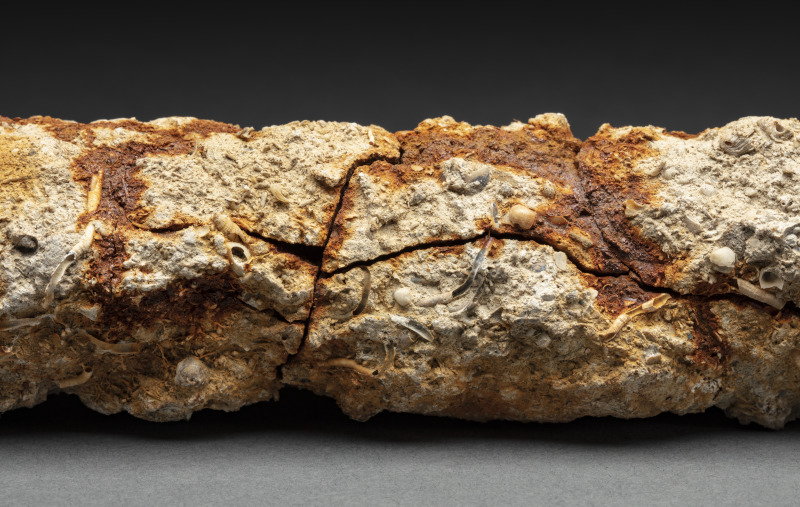
A section of underwater telegraph cable. The inner wires are insulated by gutta-percha which has a coating of tarred hemp. The outer sheathing is of galvanised iron wire. A section of the cable is encrusted with a cement-like substance.
The cable is a section of the 1871 Java to Port Darwin underwater telegraph cable, the first to connect Australia via Asia to Europe and England. The materials used to seal and protect the cable are consistent with those used at this time. The cable sample was recovered from the Timor Sea on 13 March 2016, at 11° 58.3'S / 126°00.7'E (66m water depth).
About the collection
The collection comprises a piece of cable, identified as being from the 1871-72 Port Darwin to Java underwater telegraph cable, the first to connect Australia via Asia to Europe and England, retrieved from the Timor Sea during the laying of a new submarine cable in 2016. Until the development of telegraphic communications, reliable news and information was the most highly prized cargo of ships arriving from overseas. Their journeys were often infrequent and prolonged. The Port Darwin to Banjoewangie (Java) underwater telegraph cable which opened in 1872, was the first telegraphic link between Australian and the wider world. It was the last connection in the telegraphic network for messages from England to Australia through a series of relay stations from London via Land’s End, Gibraltar, Malta, Suez, Aden, Bombay, Madras, Penang, Singapore, Batavia, Banjoewangie (then Java Dutch East Indies) to Port Darwin. Messages then continued via the Overland Telegraph to Adelaide on the route established by the expeditions of John McDouall Stuart.
Read live from the Museum's Collection API (12/11/2026, 4:58:32 am). Record last updated by the Museum 2025-02-19. Licence: https://creativecommons.org/licenses/by-nc/4.0/.