Cape Grim Air Archive bottle 1
View this record on the National Museum of Australia's website
Sign in to save favourites.
- Type
- Gas cylinders
- Place
- Antarctica
- Materials
- Ink, Metal - non specific, Paper, Plastic
- Collection
- CSIRO Oceans and Atmosphere collection
- Accession number
- 2017.0034.0002
Description
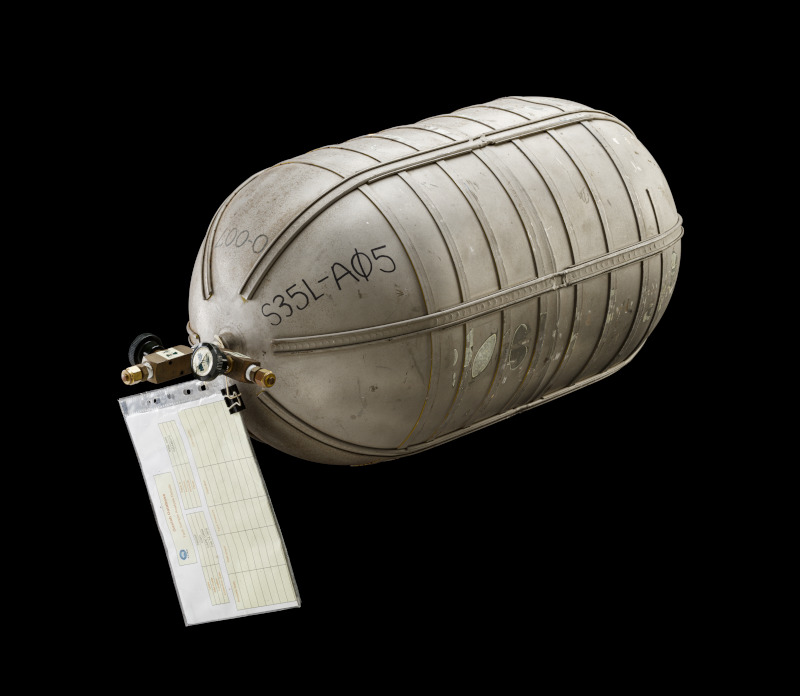
A metal gas cylinder and a gas lab data sheet. The cylinder features horizontal and vertical raised gridlines, with a pressure regulator attached which has a 'NUPRO' white and green label. The regulator is made of metal and black plastic. Handwritten with a marker in various places on the tank is 'S35L-AØ5', '0-007' and 'CG140279'. The data sheet is in a plastic sleeve folded in half with a paper clip and beige thread attached to one corner. At the top of the sheet there is a blue and white 'CSIRO' logo and orange printed text that reads 'Gaslab Database / Tank Sample Analysis Details'. Further text below it reads 'UAN 790002 / Site Code CGO / Location CAPE GRIM / Collection Date Feb 14 1979 / Tank # S#S35L-A05 / Archive CG 140279'.
World War II oxygen gas bottle used to store air samples collected in the 1970s at Cape Grim Air Monitoring Station.
About the collection
The CSIRO Oceans and Atmosphere collection comprises scientific equipment used in the analysis of atmospheric change, and fragments of Antarctic bedrock retrieved during a major ice core drilling project in 1993. All items are in good condition. In the 1980s and 1990s, David Etheridge, principal research scientist at CSIRO Oceans and Atmosphere, led a series of Antarctic field programs to investigate atmospheric composition change, climate change, and ice sheet dynamics. His analysis of atmospheric gases trapped in Antarctic ice, extracted in cores drilled by the Australian Antarctic Division, confirmed an exponential increase in carbon dioxide levels in the past century, and provided firm evidence that the increase is the result of human activity. The Cape Grim Air Archive holds air samples collected since 1978 at Cape Grim, on the north-west tip of Tasmania. Scientific analysis of Cape Grim air samples, correlated with data extracted from ice cores, significantly contributed to understandings of changes in the composition of Southern Hemispheric air. Donated by CSIRO Climate Science Centre
Read live from the Museum's Collection API (12/11/2026, 5:44:40 am). Record last updated by the Museum 2026-09-08. Licence: https://creativecommons.org/licenses/by-nc/4.0/.