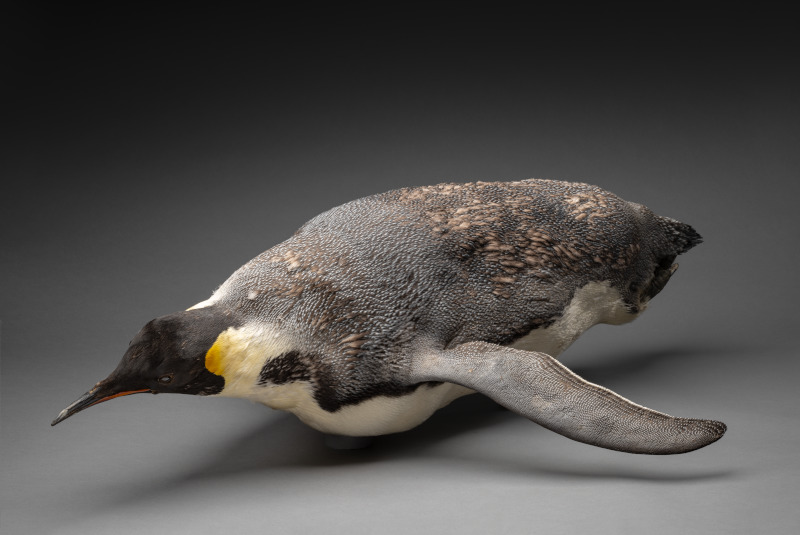
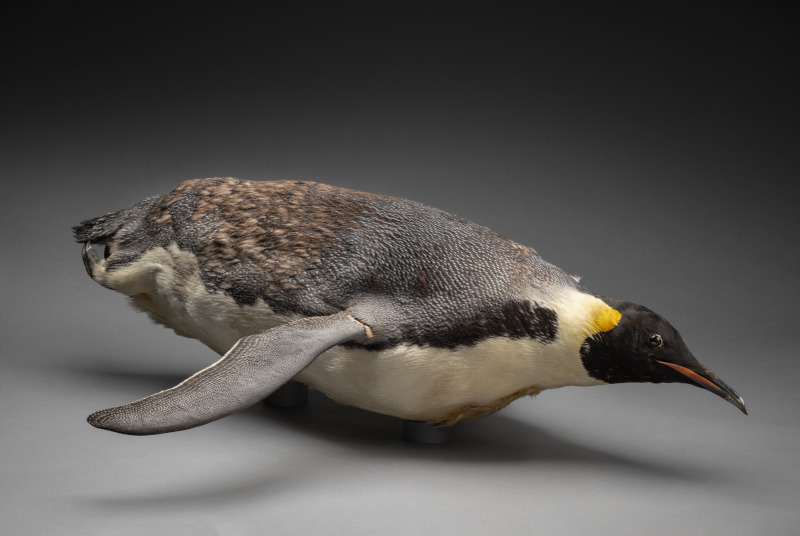
Taxidermied Emperor Penguin in prostrate pose (Aptenodytes forsteri)
View this record on the National Museum of Australia's website
Sign in to save favourites.
- Type
- Birds, Zoological specimens
- Place
- Antarctica
- Materials
- Animal material - non specific, Chemicals - non specific, Feather, Glass
- Collection
- National Antarctic Heritage collection
- Accession number
- 2024.0001.0152
Description
A taxidermied brown, black, cream and yellow adult Emperor Penguin (Aptenodytes forsteri) specimen in a prone position. The penguin's flippers are outstretched, the feet are tucked underneath the tail, and its head is tilted slightly to its left with a closed beak. There is a white substance around the edges of the proper right eye.
This taxidermied specimen was prepared by the Australian Antarctic Division to assist in scientific research, most likely prior to the 1990s.
About the collection
This collection comprises approximately 600 objects acquired by the Australian Antarctic Division and its predecessors between the 1940s and 2010s. It includes scientific and communication equipment, navigation and cartographic equipment, specimens, commemorative objects, building fabric, field support vehicles, clothing and field work supplies relating to Australia’s long and distinguished tradition of research and exploration within the Antarctic region. These objects are the largest and most diverse assemblage of surviving material culture demonstrating Australia’s relationship with the subantarctic islands and Antarctic continent between the nineteenth and twenty-first centuries. The collection offers remarkable natural and historical significance, notably nineteenth century commercial activities and the early twentieth century expeditions of Sir Douglas Mawson and other explorers that expanded scientific knowledge and laid the foundation for Australia’s enduring presence in the region. From the 1940s, the Australian National Antarctic Research Expeditions undertook major exploratory and scientific work to understand and protect the Antarctic landscape. Australia took a leading role in the International Geophysical Year and the negotiation of a comprehensive environmental protection regime for Antarctica with the establishment of the Antarctic Treaty System from 1959. It records how the Australian Antarctic Division continues to manage Australia’s interests in the Antarctic region, overseeing world-leading research at three permanent continental research stations - Mawson, Casey and Davis - and at subantarctic Macquarie Island.
Read live from the Museum's Collection API (12/11/2026, 4:58:26 am). Record last updated by the Museum 2026-11-06. Licence: https://creativecommons.org/licenses/by-nc/4.0/.