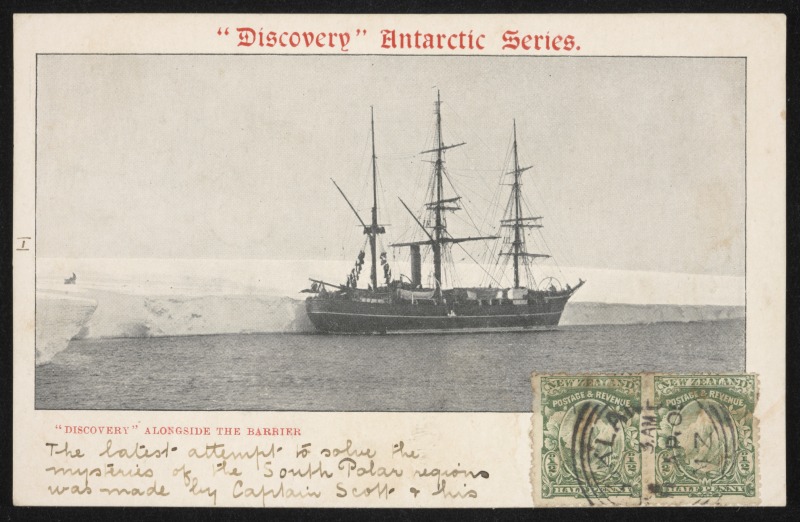
'Discovery alongside the Barrier' - postcard - 'Discovery Antarctic Series'
View this record on the National Museum of Australia's website
Sign in to save favourites.
- Type
- Photographic postcards
- Place
- Antarctica
- Materials
- Ink, Paper
- Collection
- Josef Lebovic Gallery collection no. 1
- Accession number
- 1986.0117.0150
Description
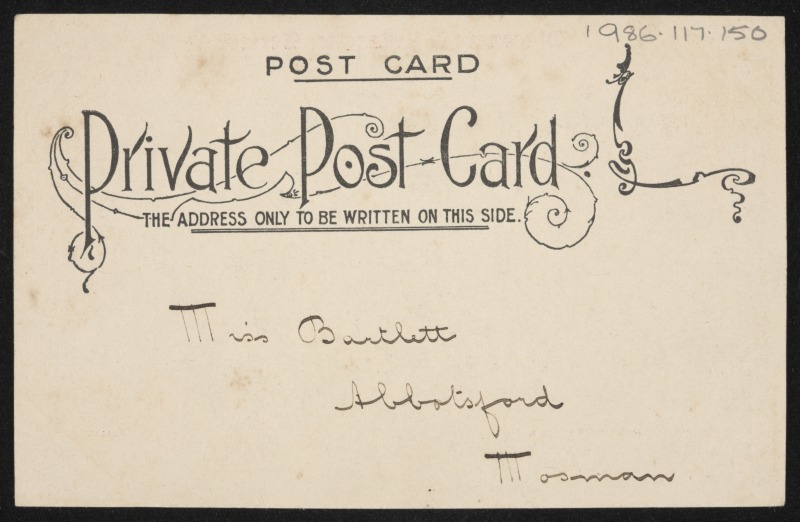
A white vignette postcard featuring a black and white photograph of the "'DISCOVERY" ALONGSIDE THE BARRIER'. The image is of a sailing boat along side an ice shelf. The postcard is from the '"Discovery" Antarctic Series'. The hand written message on the front reads 'The latest attempt to solve the mysteries of the South Polar regions was made by Captain Scott and his'. The hand written address on the reverse reads 'Miss Bartlett / Abbotsford / Mosman'.
This postcard is from the ‘Discovery Antarctic Series’ of twelve cards published in Sydney by the N.S.W. Bookstall Co, that marked the British Antarctic Expedition 1901-04, The expedition was led by Robert Falcon Scott and the party included Ernest Shackleton. This is one of seven postcards which an un unnamed writer sent to a ‘Miss Bartlett’ of Mosman in Sydney, likely soon after mid 1904. The writer’s message was distributed across the seven postcards, and reads in full: 'The latest attempt to solve the mysteries of the South Polar regions was made by Captain Scott and his companions who left Lyttelton, N.Z. in the Discovery on December 24, 1901, and reached Cape Adare on January 9, 1902. This was the most elaborately equipped and successful expedition up to that time. Captain Scott took the Discovery to the head of Ross Sea and anchored behind the island on which are the volcanoes Erebus and Terror, not far from the most southerly point reached by Ross in 1841, just 60 years earlier. Captain Scott, Lieutenant Shackleton, and one other made a long journey southwards from their winter quarters in McMurdo Bay, and reached latitude 82.17 south, which is about 463 miles from the South Pole - the farthest point south by 207 miles ever reached up to that by a human being. On December 4, 1903, the Morning together with another relief ship, the Terra Nova, sailed from Hobart, & on January 5, 1904, found the Discovery 17 miles from open water. By great exertion, and a liberal use of dynamite for blasting the ice, the Discovery after being frozen up at the foot of Mount Erebus for over 2 years - was freed. The 3 vessels proceeded to Lyttelton, which port was reached on April 1, 1904.'
Read live from the Museum's Collection API (12/11/2026, 5:00:12 am). Record last updated by the Museum 2026-10-12. Licence: https://creativecommons.org/licenses/by-nc/4.0/.