Pocket compass in case, used by John Close
View this record on the National Museum of Australia's website
Sign in to save favourites.
- Type
- Pocket compasses
- Place
- Antarctica
- Materials
- Brass, Paper, Wood
- Collection
- John Collinson Close collection
- Accession number
- 2003.0083.0002
Description
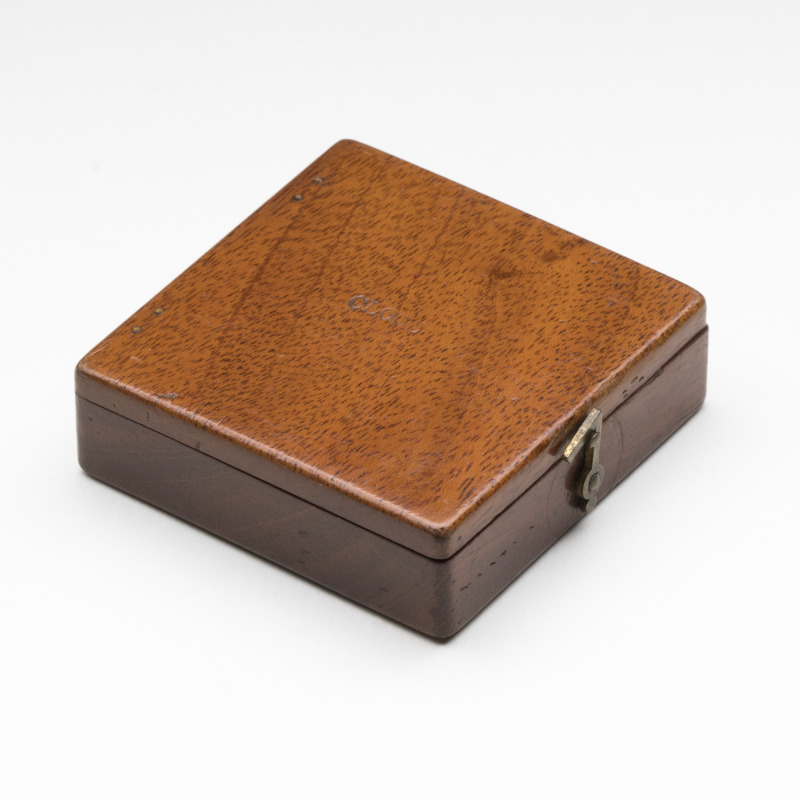
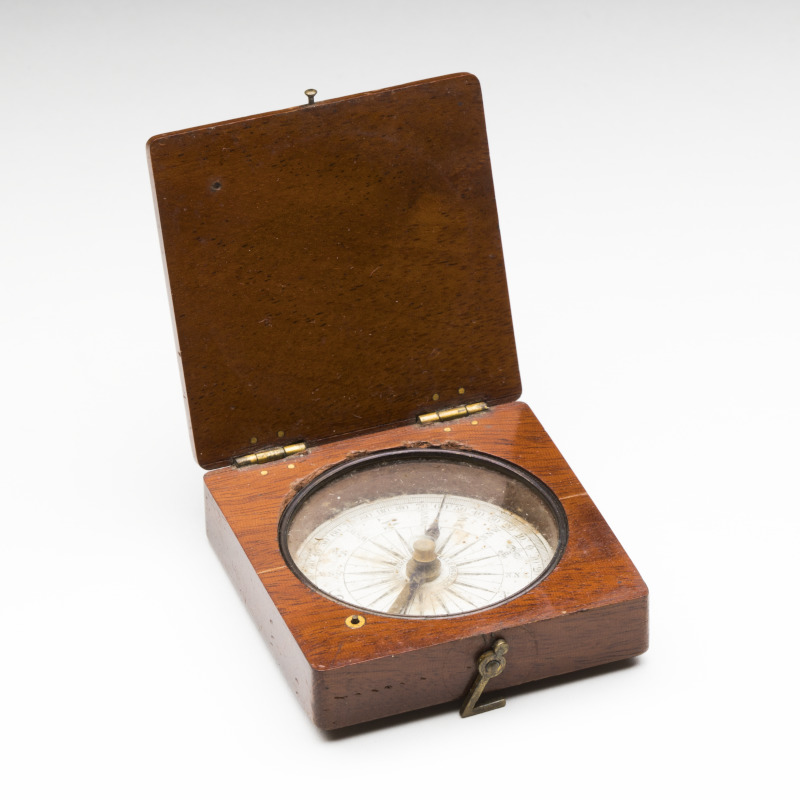
A pocket compass in a square wooden case with brass hinges which open from the rear of the case, and a brass clasp at the front of the case. The name 'CLOSE' is engraved on the lid. The compass is circular and has a blue needle with the letters 'S' and 'N' printed in a golden colour. Printed text around the centre of the compass reads 'FLAVELLE BROs & Co / SYDNEY & [?]'.
This pocket compass was used by John Collinson Close, a member of Douglas Mawson's Australasian Antarctic Expedition (AAE) of 1911-14. Close was born in Sydney in 1871 and grew up at what is now Duntroon and Yarralumla, ACT. Close was assistant collector on the expedition and later published many journal articles on his findings. The AAE was Australia's first post-Federation large-scale scientific program. It achieved some of the earliest and most comprehensive studies of Antarctic geology, glaciology, oceanography, geography, terrestrial magnetism, astronomy, meteorology, biology, zoology and botany. The expedition explored theories of continental drift; worked to define the location of the Southern Magnetic Pole; and conducted extensive hydrographical surveys between Australia and Antarctica.
About the collection
This collection comprises objects belonging to John Henry Collinson Close, a member of the Australasian Antarctic Expedition (AAE) of 1911-1914, led by Dr Douglas Mawson. It includes a telescope and case; pocket compass; Bryant and May matchbox (used to keep Close's Morse code); diary entries and letters from Close to his wife Alice (three on AAE letterhead); a hand-stitched canvas pouch with a label written by Close in ink, containing two rock samples collected in Antarctica and sent to Alice by supply ship in 1912; a copy of Life Magazine from September 1914; newspaper cuttings of eight articles written by or referencing Close; three typescript letters, including correspondence from Douglas Mawson; handwritten copies of two poems, including one by Tennyson; a newspaper cutting of a Douglas Stewart poem; and a registered envelope addressed to Close. The John Collinson Close collection dates from the 'heroic era' of Antarctic exploration, perhaps the last great period of geographical discovery on Earth. It demonstrates key events in a story that led to Australia's claim over 42% of the continent. Linked to this story, and to this collection, are simultaneous ties to the old notions of Empire and the assertion of a new national identity. Close's private letters and journalism reveal the contrast between the personal experiences of a lesser-known expeditioner and a venture, overshadowed by a mythologised leader, now abstracted into the national memory and imagination.
Read live from the Museum's Collection API (12/11/2026, 4:58:13 am). Record last updated by the Museum 2026-05-04. Licence: https://creativecommons.org/licenses/by-nc/4.0/.