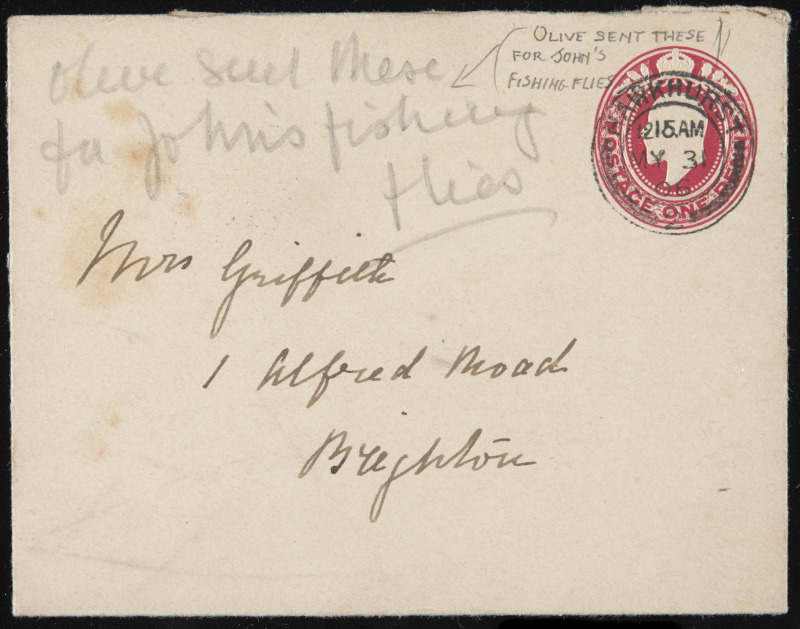
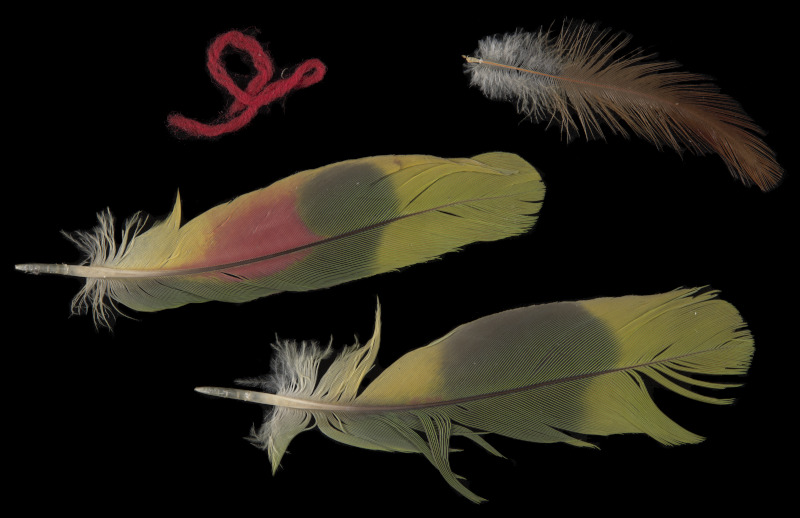
Envelope containing feathers for fishing flies
View this record on the National Museum of Australia's website
Sign in to save favourites.
- Type
- Feathers
- Place
- England
- Materials
- Feather, Paper, Wool - non specific
- Collection
- Alfred Ronalds collection
- Accession number
- 2004.0061.0001.002
Description
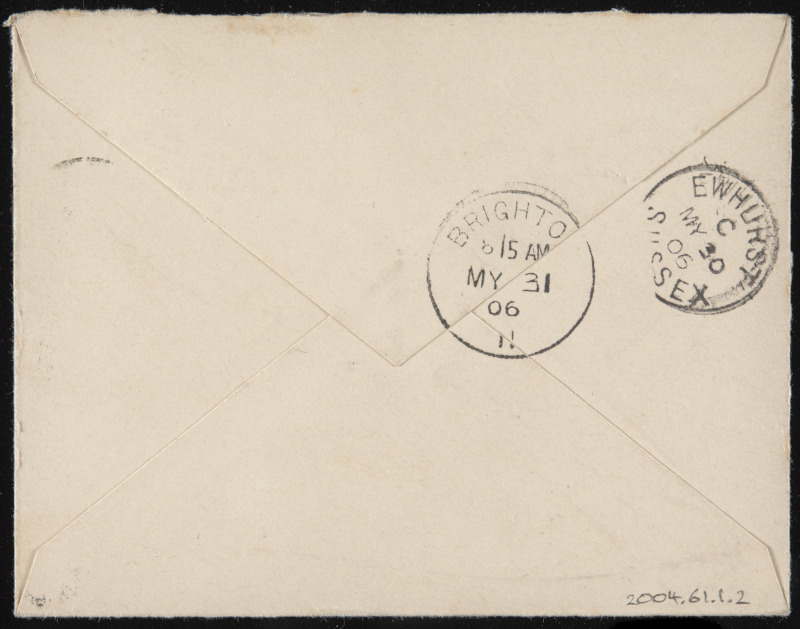
A small cream envelope with a red circular stamp, addressed in black ink to "Mrs Griffith / 1 Alfred Road / Brighton". The top has been slit open and the envelope contains two lime green feathers, a smaller fawn-coloured one, and a short length of red wool. "Olive sent these for John's fishing flies" is written in pencil twice above the address, one in freehand and the other in capital letters. The letter is postmarked three times on the front and back, with the dates 30 and 31 May 1906.
About the collection
The Alfred Ronalds Collection consists of a copy of the third edition of The Fly-Fisher's Entomology, published in England in 1844. The book contains a detailed description of the art of fly-fishing, plus fifty artificial flies and instructions about how to make them. There are also twenty plates displaying a hundred delicately coloured illustrations of insects and their imitations. This copy of the book was owned by A J Lane, an early fly-fishing enthusiast. Writing in his journal of 1843, Lane describes the fish, the fishing, and the flies of southern England in great detail. A J Lane has embellished this book with thirty-two mounted artificial flies, and added extensive notes. Alfred Ronalds first published The Fly-Fisher's Entomology in 1836, the result of his thoughts, observations and experiments undertaken in a purpose-built hut on the banks of the Blythe River in Staffordshire, England. Acclaim for Ronalds and his book, was immediate and long-lasting. It is still regarded as one of the greatest achievements in angling literature, particularly in connecting the practice of fly-fishing with the science of entomology. The scientific basis of the book influenced angling techniques and their consequent development world wide. The fame of Alfred Ronalds and his book preceded his arrival in Australia. He died in 1860, just four years before trout were introduced to Australia by Tasmanian pastoralist James Youl. Ronalds' daughter, Maria Shanklin, continued the tradition of fly-tying during the 1860s and 1870s, and her design, named the Wennel, is still used by Australian fly-fishers. Fly-fishing today is one of the most popular forms of fishing in Australia.
Read live from the Museum's Collection API (12/11/2026, 5:44:39 am). Record last updated by the Museum 2021-05-11. Licence: https://creativecommons.org/licenses/by-nc/4.0/.