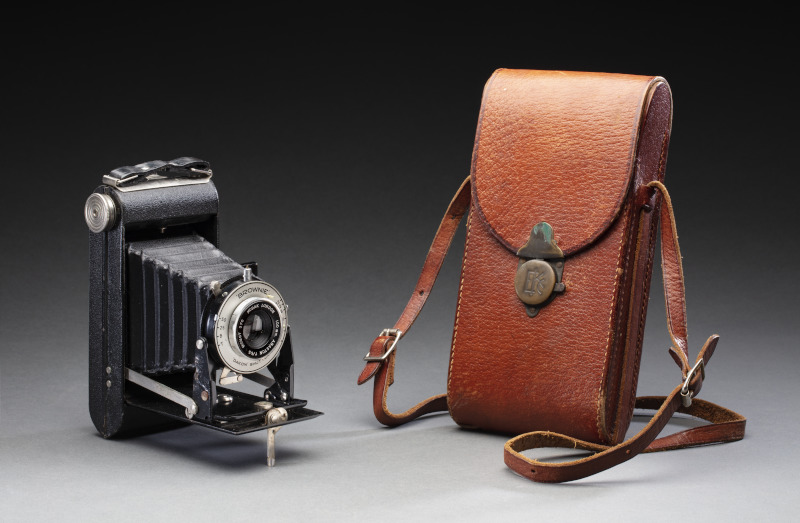
Black Kodak camera and case
View this record on the National Museum of Australia's website
Sign in to save favourites.
- Type
- Photographic equipment
- Collection
- Springfield - Faithfull Family collection
- Accession number
- 2005.0005.0102
Description
Black Kodak camera, slimline in brown leather case. Black slimline Kodak Box Brownie folding camera with a painted metal body. A front opening allows the lens which is set in a leather concertina frame to fold out. There is a folding optical frame finder on the side. A metal plate is attached to the top of the camera with square metal loops on either side holding a short leather strap with two metal studs. The back of the camera has one black stud and one round red glass inset. Engraved on the inner lens surround "KODAK LONDON / 100 mm. ANASTON f / 6.3 / MOUNT 370". Stamped on outer lens surround "'BROWNIE' / 32/ 22 / 16 / 11 / 8/ 6.3"; 'DAKON' SHUTTER / T / B / 25 / 50". Stamped on plate attached to inside of cover "SIX - 20 FOLDING 'BROWNIE' / MADE IN GREAT BRITAIN". Tan leather camera case with flap opening to top. Metal latch attached to flap which fits into a round metal clasp on centre front of the case. A leather strap with two metal buckles is threaded through the base and sides of the case. Engraved on the metal frame of the clasp "MADE IN U. S. A"; engraved on the clasp an intertwined "EKC". Stamped in leather above the clasp "KODAK CASE / MADE IN AUSTRALIA". Handwritten inside flap "Diana Maple-Brown".
About the collection
The Springfield Collection comprises about 1550 artefacts from Springfield station, south of Goulburn. It includes colonial era costume, a bushranger medal, surveying instruments, a late-19th century landau, firearms and edged weapons, wool samples and Joseph Foveaux's pocket watch and bible. The objects are complemented by over 400 photographs. This diverse collection reflects the growth and economic success of the property, responses to changes in the wool market and the daily lives of the people who have lived on Springfield. Springfield has grown from a 518-hectare land grant given to William Pitt Faithfull in 1828 to the current 3183 hectares with ownership remaining in the one family. William Pitt Faithfull established the Springfield Merino Stud in 1838 with ten rams selected from the Macarthur Camden Park stud. The stud evolved slowly over the years until the early 1950s when, under the management of Jim Maple-Brown, a scientific approach to wool-growing was adopted and the stud's name was changed to Fonthill to reflect this.
Read live from the Museum's Collection API (12/11/2026, 6:26:24 am). Record last updated by the Museum 2025-04-11. Licence: https://creativecommons.org/licenses/by-nc/4.0/.