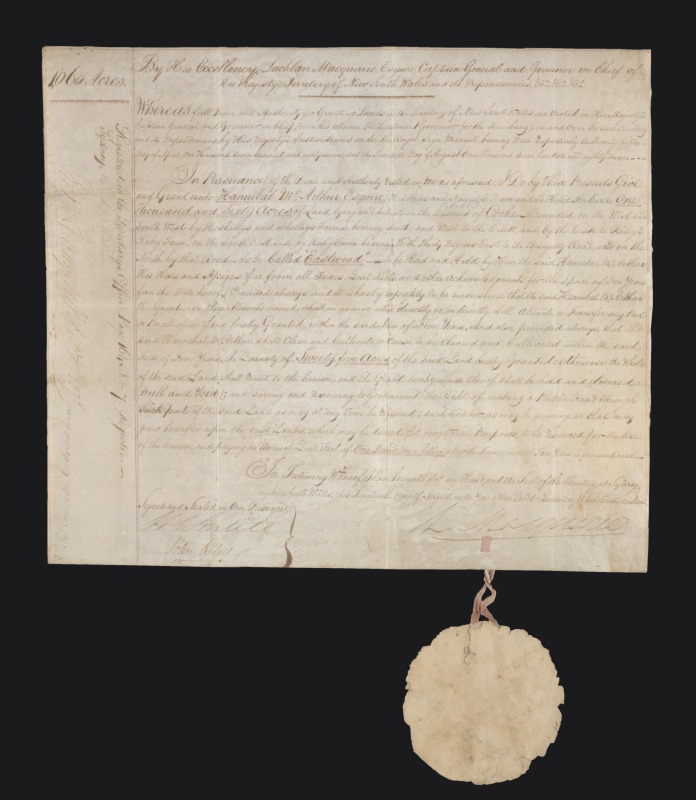
Land grant issued to Hannibal Macarthur signed by Governor Lachlan Macquarie, 17 August 1819
View this record on the National Museum of Australia's website
Sign in to save favourites.
- Type
- Deeds
- Date
- 17 August 1819
- Place
- Sydney, New South Wales, Australia
- Materials
- Ink, Parchment, Textile - non specific
- Collection
- Colonial Land Grants collection
- Accession number
- 2005.0104.0003
Description
A land grant handwritten in black ink on parchment signed by both Governor Lachlan Macquarie and the recipient, Hannibal Macarthur, dated 17th August 1819. The grant, for one thousand and sixty acres in the District of Cooke to be called 'Eastwood', is witnessed by Henry Colden Antill and John Riley. On the back of the document both Macarthur and Sir Edward Deas Thomson, the Colonial Secretary and Registrar, have signed a statement in which Macarthur resigns his interest in another parcel of land on the receipt of this grant. There is a circular paper seal, which is suspended by a length of fabric.
Hannibal Macarthur was the son of John Macarthur's older brother James, and first arrived in the Colony in 1805 when persuaded to accompanied his Uncle. During John Macarthur's protracted absences from the Colony, Hannibal acted as his agent in a number of undertakings, usually earning his uncle's displeasure for not being sharp enough. He married Anna Maria King, daughter of Governor King, in 1812 and bought his first property, 'the Vineyard' in Parramatta, the following year. In 1814 he unsuccessfully applied for a land grant from Macquarie, and when he complained to his uncle was told by him that he would be unable to apply pressure on the Governor to have the decision reversed. Five years later the grant was finally given, and Hannibal went on to become one of the major figures in the wool industry in the Colony.
About the collection
The Colonial Land Grants collection comprises four land grants ranging in date from 1792 to 1831. All are hand written, with two on paper and two on vellum. The earliest grant was given by Governor Arthur Phillip, two were issued by Governor Lachlan Macquarie and one by Governor Ralph Darling. The three later land grants are in relatively good condition, but the earliest grant, dating from 1792, is faded and worn. The Colonial Land Grants collection documents the evolving process of land alienation in Australia, a primary activity of colonisation and one carried out to the great detriment of Indigenous Australians. While the settlement in the New South Wales was established as a prison, Governor Phillip's commission enabled him to grant land. For the colonisers, land was a source of wealth and status and successive Governors used land grants as rewards; either for good behaviour in convicts, or for excellence in service to the community, or for bringing in capital. The more modes - and ultimately unviable - size of the grants given to emancipated convicts limited the challenge they posed to the existing social order.
Read live from the Museum's Collection API (12/11/2026, 4:58:21 am). Record last updated by the Museum 2025-02-24. Licence: https://creativecommons.org/licenses/by-nc/4.0/.